
Luxury retail fit-out · Sephora illuminated fixture walls + delivery service
Sephora Luxury Retail Fit-Out — Metal Fabrication Materials, Mock-Up and Delivery
How a Sephora luxury retail fit-out is proved before production: the 1:1 mock-up of the illuminated fixture walls, the metal fabrication materials behind them, the eleven delivery gates, the nine questions the design team asked, and the five problems that became rules — photographed in our Foshan workshop.
The project
A closer look at the brief.
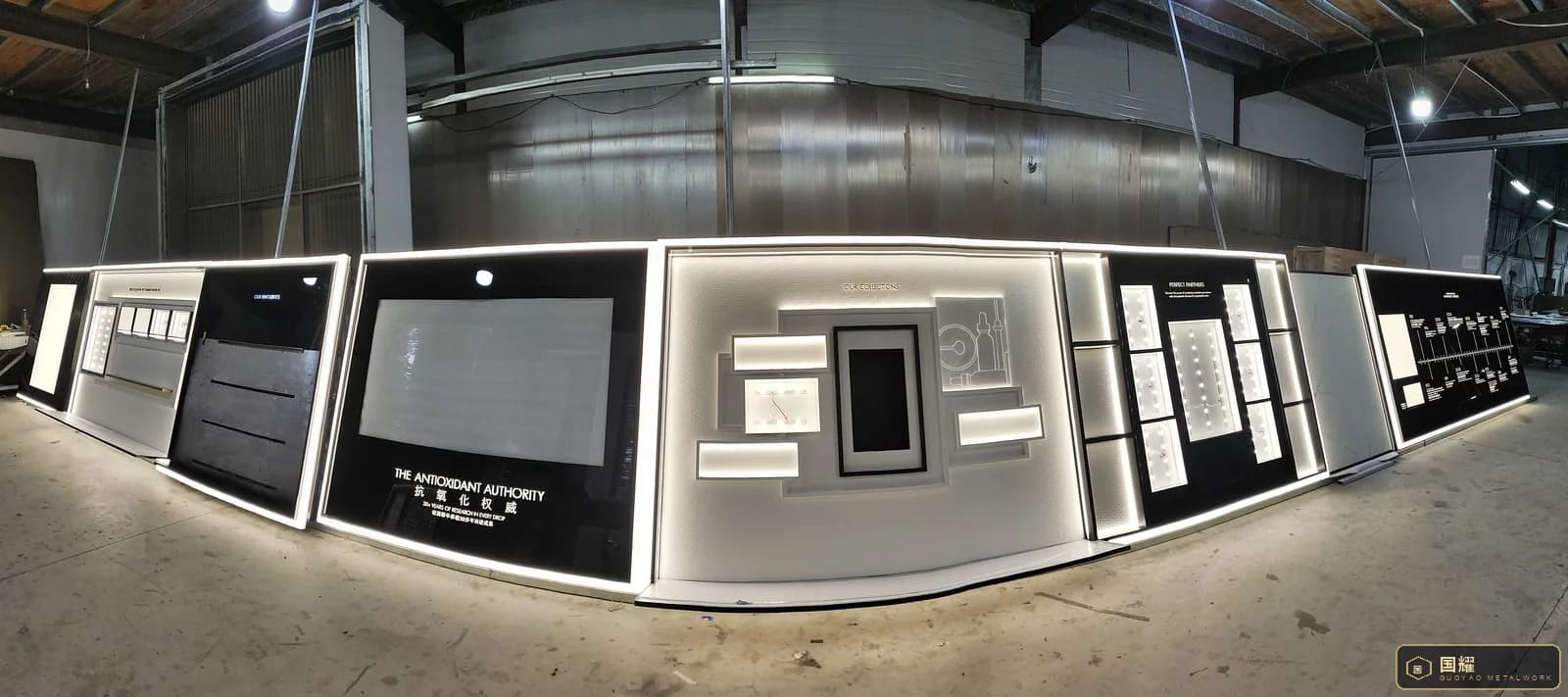
A beauty floor is the most photographed interior type in retail, and the brightest thing in most of those photographs is the fixture itself. Sephora builds its walls around that fact: a band of light drawn round each panel like a picture frame, a textured metal or matte black face inside it, product set on lit shelves in between. None of that can be judged from a drawing, because a drawing cannot show what happens where an LED strip meets a mitred corner. So the wall is built first — full size, eight bays in a row, lit — and the light is approved before a production panel is cut. This is how that luxury retail fit-out was delivered: the metal fabrication materials behind it, eleven gates, nine questions from the design team, and the five problems that turned into rules. Eight bays, one row, all lit at once. The only place the system can be judged as a system: brightness against brightness, colour against colour, seam against seam.
- Environment mock-up built at full size before production
- 1:1
- Bays in the mock-up row, lit together for comparison
- 8
- Brightness tolerance across one row of lit frames
- ±5%
- Mitre tolerance where a lit band turns a corner
- 0.2 mm
- Delivery gates, each with a written sign-off
- 11
01 / 00 · What clients buy
Nobody orders a wall. They order the certainty that the light will be even at ten in the morning.
In luxury retail fit-out the object and the process cannot be separated. Geometry comes from the brand's fixture drawings, brightness from a lighting designer, surface from a materials board, programme from a store that trades seven days a week. What the client buys is three things at once, and all three are judged by a customer holding a phone.
Most fixture failures are not failures of skill. They are failures of judgement in the wrong light — a finish signed off in daylight, a brightness set in a dark workshop, a colour approved on a screen. The mock-up exists to move those judgements into a room where they can still be corrected cheaply.
The line the designer drew
A continuous band of light round every panel: same width, same brightness, same colour, turning each corner without a dim spot or visible joint. On these walls the frame is not decoration, it is the graphic — a band that kinks by a millimetre at one corner is found from across the aisle.
The surface that has to survive the public
Textured stainless that hides fingerprints but shows every dent; matte black that must not go shiny where hands rest; acrylic that must not yellow in front of the lamps it sits behind. Sixteen trading hours, testers, sanitising alcohol and a nightly wipe-down belong in the metal fabrication specification, not in a footnote.
The record the brand can audit
Which bay is which, which LED batch sits in which frame, what the face brightness measured at sign-off, which artwork revision was printed, and how a panel comes off when a driver fails in year four. A fixture package is a maintenance problem wearing the clothes of a drawing.
02 / 01 · Sephora and the wall
Sephora has sold other people's brands since 1969. Its walls have to hold all of them.
Sephora opened in Limoges in 1969 and has been part of LVMH since 1997; it now runs some three thousand stores across more than thirty markets. It is a curated house of brands rather than a single-brand house, and that shapes the fixtures: the store's own walls and the partner walls inside them must read as one family while carrying completely different graphics.
That is the problem the mock-up answers. A Sephora wall is a kit of common parts — lit perimeter, matte black liner, textured face, illuminated shelf boxes, recessed niche — recombined for each bay. House walls carry brand typography; a partner wall may carry a research timeline instead, small type that has to stay legible under the same lamps.
Then there is the retail physics, which is stricter than the design. Everything is photographed, so a band 8% dimmer at one corner is invisible to the eye and obvious in the picture. Everything is touched and cleaned, which makes the finish schedule a durability document as much as a colour one. And everything goes in overnight — a trading store gives a night window, so bays are modules that fit the service lift, wired with plug-in connectors and numbered in the order they will be hung.
A fixture is finished when the customer's photograph looks like the rendering. — The brief, as the design team put it
03 / 02 · Delivery gates
A wall is delivered eleven times before it is delivered once.
Each gate ends with a document and a signature. The point is not administration: a decision made at gate five cannot be quietly reversed at gate nine, when the extrusions are cut. Every gate is a place where the package can still be stopped cheaply.
Gate 07 is the one that saves the project, and the one clients most often compress. Approved bay by bay, a mock-up produces eight separate opinions; the same eight bays lit in a row produce one.
| # | Gate | What is fixed here | Evidence produced |
|---|---|---|---|
| 01 | Brief and drawing intake | Fixture elevations, lighting design, materials board, artwork files, store power and fixing conditions. | Drawing register, RFI list, responsibility matrix |
| 02 | Design coordination | How the lit frame, liner, face panel and shelf boxes meet; where the driver and wiring live; how each bay is serviced. | Coordinated sections, approved by designer and lighting consultant |
| 03 | Mock-up scope | Which bays are built at 1:1, in what order, in which finishes, and what "approved" will mean. | Mock-up schedule, approval criteria |
| 04 | Material and light release | Stainless grade and pattern direction, powder coat colour and gloss, acrylic grade, LED bin, CCT and driver. | Material submittal, LED batch record |
| 05 | Mock-up build | Frame extrusion, mitre and weld, diffuser set-back, textured face, shelf boxes, artwork mounting, wiring. | Mock-up photographs, dimensional record |
| 06 | Light measurement | Face brightness on a grid, colour temperature, corner fall-off — measured, not eyeballed. | Lux and CCT report per bay |
| 07 | Design sign-off | Whole row viewed together, at trading distance and at arm's length, in the specified lighting. | Signed approval with marked-up photographs |
| 08 | Production | Cutting, forming, welding, coating, print, assembly, wiring — to the approved mock-up, not to the drawing alone. | Inspection records at three hold points |
| 09 | Pre-delivery assembly | Every bay assembled and lit in the factory, then dismantled and numbered. | Trial-fit report, crate list |
| 10 | Protection and shipping | Film, corner protection, crate design, cross-border documents, store delivery window. | Packing list, delivery receipts |
| 11 | Installation and handover | Night-window sequencing, levelling, wiring, brightness re-check on site, cleaning, dossier and spares. | Installation log, site light report, handover file |
04 / 03 · The nine questions
What a design team asks before a single extrusion is cut.
These came back in the first two weeks, written the way they were actually asked. None is unreasonable; several are the reason the package held together. Each has a manufacturing answer — and the answer is usually a decision taken earlier than the question implies.
Notice how many of the nine are answered by sequence rather than by craft: mock-up before production, measure before approve, print in one run. The craft is assumed. What a client buys is a supplier who has thought about the order in which things happen.
| # | The question, as asked | What we do about it |
|---|---|---|
| 01 | "Will the light band be even round the corners?" | Run the strip continuously around the corner instead of terminating each leg, and put a reflective insert behind the mitre. Then measure the corner: within 5% of the face. |
| 02 | "Will we see the individual LEDs as dots?" | Set the pitch against the diffuser distance. 25 mm behind 6 mm scallops; 12 mm behind 8 mm does not. The mock-up proves that arithmetic instead of arguing it. |
| 03 | "Will the whites match across the row?" | One bin, one batch, one driver type for the package; measure CCT at every bay and reject anything more than 100 K from the reference. |
| 04 | "Will the textured sheet show a dent?" | Specify sheet thickness and subframe spacing together. A pattern hides fingerprints and amplifies oil-canning: back it at 300 mm centres, fix in slotted holes. |
| 05 | "Will the mitre show when it is lit?" | Cut, weld and dress the mitre, then check it under the lamp rather than in daylight. A lit joint is a shadow test: 0.2 mm of mismatch reads as a step. |
| 06 | "Will the graphics stay black?" | Print the package in one run, on one substrate batch, away from lamp heat. Two runs of "black" are two different blacks, and the joint between them is where the eye lands. |
| 07 | "Will the light box yellow the acrylic?" | Vent the cavity, use a heat-rated diffuser, and burn in the assembly at working temperature for 200 hours before release. |
| 08 | "Can it go in in one night?" | Design the bay as a module that fits the service lift, with plug-in connectors and a numbered crate sequence. No cutting, spraying or drilling finished surfaces on site. |
| 09 | "How is a failed driver replaced in year four?" | Make the cavity accessible from the front: the face lifts out, the driver sits on a service loop, the wiring diagram is on the inside of the panel — not in a folder in an office. |
05 / 04 · The 1:1 mock-up
We build the wall twice. The first one is the argument.
A fixture drawing is a set of intentions. The mock-up is where those intentions meet 1.2 mm stainless, a 12 mm extrusion, a 90-degree mitre and a driver that has to fit in 40 mm of depth. None of that meeting is visible on paper, which is why the first full-size bay is built before anything else is released.
A mock-up is not a sample board. A sample board shows a finish; a mock-up shows a wall — frame, liner, face, shelf boxes, artwork and light, assembled the way they will be in the store, viewed from three metres and then from 300 mm. The two distances disagree: at three metres it reads as a graphic, at 300 mm as a set of joints. Both are part of the brief.
We build the first bay, photograph it and mark it up with the design team before building the next seven. Then the row is lit together and the argument shifts from "is this bay correct?" to "does this row agree?" Eight bays individually correct can still read as eight different walls if their brightness or their whites differ — and only a row shows that.
The last thing the mock-up settles is the depth budget. Behind each face panel there is a light cavity, a driver, a connector and, in the shelf boxes, a little cabling. On a wall drawn 120 mm deep, the difference between 40 mm and 55 mm of cavity is the difference between an even band and a hot stripe. Resolving that in a mock-up costs a week; resolving it on site costs the opening date.
06 / 05 · The lit perimeter
A glowing frame is a seam test with a light behind it.
The perimeter band is the fixture's signature and its most unforgiving element: a closed loop of light about 40 mm wide, running round four sides of every bay and turning a right angle at each corner. Everything acceptable in a painted frame becomes visible in a lit one — a joint, a step, a twist, a shadow, a brightness difference.
Three things have to be right at once. The geometry: the extrusion is mitred at 45 degrees, welded and dressed so the band's inner and outer edges run continuously through the corner. The light: the strip runs continuously around the corner instead of stopping at each leg, because a strip that terminates 40 mm short leaves a dark notch exactly where the eye is drawn. The diffusion: the opal panel sits far enough from the LEDs that the diodes merge into a line, and close enough that the band does not lose intensity at its edges.
We measure rather than judge. A lux meter on a grid around the band gives a brightness profile, and the corner is compared with the middle of the top run. The acceptance is 5% across the row and 8% at a corner, with CCT within 100 K of reference. Those are not arbitrary numbers: at 10% the band starts to read as two materials, and at 200 K the whites look like two lamps.
The frame is structural too, which is easy to forget while looking at the light. It carries the face panel, the liner and, on some bays, the shelf boxes; it is the part the installer levels and the next bay bolts to. A 12 mm extrusion with a 3 mm wall holds a 1.2 m panel flat; the same profile in 1.5 mm bows between fixings and takes the light band with it. Most "uneven light" complaints we are shown from other projects turn out to be a frame that moved, not an LED that failed.
The band is not lit. It is proved. — Workshop rule, written on the mock-up bay wall
07 / 06 · Metal fabrication materials
A pattern hides the fingerprints and advertises the dents.
The material schedule for a luxury store fit-out is short and specific, and every line of it is a performance requirement disguised as a finish. Textured stainless is chosen because a flat brushed panel records every hand that touches it and a beauty floor has a lot of hands. The pattern breaks up the reflection — and turns the panel into a shallow mirror that reveals flatness, because every wave catches the light at a different angle.
Sheet arrives flat and leaves the factory flatter. The pattern is rolled into 1.2 mm stainless and the forming leaves a slight bow, invisible on a bench and obvious on a wall. We check it against a straight edge on the diagonal, then fix it to a subframe at 300 mm centres in slotted holes, so the panel moves with temperature without oil-canning between fixings. Direction matters as much: two adjacent panels laid at 90 degrees read as two materials under grazing light, so every panel in a bay is cut from the same coil, in the same direction, and marked on the back.
Matte black is a lighting decision as much as a colour one. At 5% gloss the face absorbs the band's spill and the product boxes read as the only light source; at 30% the whole wall becomes a mirror for the aisle. We spray test panels at the specified gloss and put them in the mock-up under the real lamps before the batch is released — the same discipline that keeps a coated brass panel from being cleaned with the wrong pad in year two.
| Material | Where it is used | Why this grade or finish |
|---|---|---|
| Textured stainless, 1.2 mm | Face panels, feature walls | Hides handling marks; requires 300 mm backing and a consistent pattern direction |
| Brushed stainless, 1.5 mm | Liners, niche returns, reveals | Fine grain reads as shadow line at 2 mm; flat enough not to distort the reveal |
| Brushed brass, clear-coated | Bottle aperture, shelf edges | Warm metal under 3000 K light; the coat is what makes it cleanable |
| Aluminium extrusion | Lit perimeter, 12 mm profile | Straightness over 2.4 m; 3 mm wall so the band cannot bow |
| Powder coat, matte | Black faces, pale faces | 5% gloss absorbs the band's spill; heat-rated within 150 mm of a lamp |
| Opal acrylic, heat-rated | Diffusers in frames and boxes | Merges the diodes into a line; resists yellowing at working temperature |
08 / 07 · Niche and aperture
The reveal is two millimetres, and the aperture is where light behaves worst.
Every bay has a niche: a recessed opening with a dark liner, set into a pale face, holding a screen, a mirror or a single product under a dedicated light. It is the smallest element on the wall and the one that carries the most weight, because it is where the eye rests — and where a millimetre of error is visible from three metres.
A niche is four parts that have to agree: the opening in the face panel, the liner that turns the reveal, the back panel that closes it, and the frame in front. The reveal is set at 2 mm — wide enough to read as a deliberate shadow line, narrow enough not to become a gap. The liner is a folded section rather than four mitred strips wherever geometry allows, because a folded corner has no joint to open under light. The frame is set on adjustable brackets so the reveal can be equalised on site: buildings are not square, and a 2 mm reveal on a wall 3 mm out of plumb has to be set by hand.
The hardest detail in the package is the one that is most literally brand imagery: a bottle-shaped aperture cut through a brushed brass panel with a frosted diffuser behind it, so the product's silhouette glows out of the wall. The cut is the easy part. The difficulty is the edge — a square-cut edge catches the diffuser's light and draws a bright rim, turning a soft silhouette into a neon outline. So the edge is chamfered back about 1.5 mm on the face side, the diffuser sits 40 mm behind the panel, and the cavity is painted matte black so no light bounces forward around the perimeter.
09 / 08 · Problem log
Five things went wrong. Each one became a rule.
This is the part of the record a client should read first. A supplier who claims no problems on an illuminated fixture package has either not measured or not written them down.
The first lit frame had a dark notch at every corner
The strip had been run as four legs, each stopping 40 mm short of the corner to leave room for the mitre. Measured at the face, the corner read 22% below the middle of the top run — invisible in ambient light, obvious in a photograph. What changed: the strip now runs continuously around the corner on a flexible link, with a reflective insert behind the mitre. The corner re-measured at 4% of the face, and corner brightness became a line on the light report instead of a matter of opinion.
The diffuser showed the LEDs as a row of dots
A 25 mm pitch strip behind a 6 mm opal diffuser looked like a string of beads at arm's length — and from three metres, worse: a bright line with a ripple that the camera picks up. What changed: pitch halved to 12 mm, diffuser stand-off increased to 8 mm. The arithmetic — pitch against distance — is now done at gate 04, before the strip is ordered, rather than discovered at gate 06.
Two bays read as two different whites
Bays built a week apart carried strip from two batches. Both nominally 4000 K; measured, 140 K apart. Side by side, one read warm and one read clinical, and the joint between them was the first thing anyone saw. What changed: one bin, one batch, one driver type for the whole package, ordered at gate 04 and stored together. Every bay is measured against a reference bay; anything over 100 K is rejected.
The textured panel oil-canned between its fixings
A 1.6 m face panel fixed at 600 mm centres looked flat on the bench and showed a shallow wave on the wall, most visible where the light band ran along its top edge. The pattern amplified it: every wave caught the band at a different angle. What changed: subframe centres reduced to 300 mm, fixings changed to slotted holes, panels over 1.2 m given a folded return. Flatness is checked against a straight edge on the diagonal before a panel leaves the bench.
The bottle aperture showed a bright ring
The first cut had a square edge with the diffuser 15 mm behind it. Light escaping around the perimeter produced a halo that made the silhouette look like a neon sign — the opposite of the soft glow the design asked for. What changed: the face edge is chamfered 1.5 mm, the diffuser moved back to 40 mm, the cavity painted matte black. The silhouette now fades into the brass instead of being outlined by it.
10 / 09 · Protection & installation
The store opens at ten. At nine it has to look as if nothing happened.
A finished bay leaves the bench in the best condition it will ever be in. From that moment every operation — wrapping, crating, the truck, the border, the back corridor, the other trades — is a chance to lose it. Which is why protection is designed, not improvised, and why installation is a sequence written before anyone travels.
Each bay is wrapped in UV-stable film with a sacrificial layer on the corners and along the lit band, the part that cannot be repaired on site: a dented extrusion shows as a kink in the light. Face panels travel separately in cradles, textured side inwards; brass gets its own case, because brass marks against anything harder than itself. Crates are kits, not boxes — one per bay, contents in the order the installer needs them, crate list matched to the bay numbers. On a night window that is the difference between finishing at 04:00 and finishing at 07:00 with the cleaners waiting.
On site the bay is levelled first, on packers and a laser, because the lit band is a horizontal line and a wall 4 mm out of level reads as a sloping frame. The frame is fixed to structure, never to plasterboard alone; wiring is plugged, not jointed. Then the face goes on, the reveal is equalised, and the light is measured again — the store's ambient light changes what the eye reads, so adjustment happens at the driver and the new value goes on the light report.
The last operation on any bay is not installation. It is removal — film, labels, paint-pen marks, protective board, dust, footprints. A wall that is correctly built and badly cleaned up looks like a wall that was built badly, and the client has no way to tell the difference.
11 / 10 · Handover file
What the store keeps after we leave.
A fixture package is a five-to-ten-year object in a store that will be refreshed at least once in that time. The handover file is written for the person who will one day change a driver at 09:00 before opening, or match a textured panel after a trolley impact, or explain to a cleaning contractor why an abrasive pad is not acceptable.
The spares deserve a sentence of their own. An LED strip is a cheap object and an unmatched strip is an expensive one: after two years the bin is gone, and a replacement from a different batch reads as a different white on a wall where everything is compared. Two metres of the same batch, kept in the back of house with the light report, turn a future repair from a procurement exercise into twenty minutes of work.
As-built elevations
— every bay numbered, with dimensions, reveal sizes and fixing positions
Light report
— face brightness and CCT on a grid, per bay, workshop and site
LED and driver schedule
— bin, batch, CCT, wattage, driver type and location
Finish schedule
— powder coat colour and gloss, stainless grade and pattern, brass coating
Mock-up approval set
— signed photographs, including the revision that was rejected
Artwork record
— print files, substrate batch, colour target and approved proof
Wiring diagrams
— one per bay type, also fixed inside the panel for the technician
Assembly and service manual
— how the face lifts out and how the driver is reached
Installation log
— night windows, sequence, attendance, and any deviation with its reason
Cleaning protocol
— what may be used, and what must never touch a coated brass
Spares
— one face panel blank, two metres of LED strip, one driver, fixings, touch-up kit
Warranty and response terms
— what is covered, for how long, and who answers the call
12 / 11 · Start here
Three things we ask for before we quote a lit wall.
A fixture package can be priced from a drawing, but it cannot be delivered from one. These three inputs turn a number into a programme.
Send the elevations, one section through the lit frame, and the brightness target. We will come back with a mock-up scope, a light-measurement method and a delivery sequence — before anyone talks about a price per bay.
Elevations and sections
The fixture elevations, a section through the frame showing the light cavity, and the materials board. If the artwork is still moving, send the latest revision and the date it has to be frozen.
Brightness, colour and control
The CCT and brightness the lighting designer wants at the face, whether bays are dimmable or switched, and where drivers may live. These decide the extrusion depth, which decides everything else.
Programme and access
When the store can be worked in, the size of the service lift, the route from the loading bay, and who signs the protection protocol. These decide module sizes and crate sequence.
Project reflections
From the brief to the detail.
GUOYAO METAL · Foshan, Guangdong · Luxury retail fit-out and architectural metalwork Service & delivery record · Sephora fixture package Sephora is a trademark of Sephora S.A. and part of the LVMH group; SkinCeuticals is a trademark of its respective owner. GUOYAO is an independent metal fabricator and is not affiliated with, endorsed by or acting as agent for Sephora, LVMH or any brand named on the fixture graphics shown here. Photographs reproduce client artwork in our workshop for the purpose of describing our own fabrication and delivery scope; brand information is taken from public sources.